Venous Disease &
Chronic Insufficiency
Clinical Guide Contents
Experiencing Heavy, Aching Legs or Varicose Veins?
Book EvaluationExperiencing Heavy, Aching Legs or Varicose Veins?
What is Venous Disease?
Venous disease is common and can affect your comfort, mobility, and quality of life. It occurs when the veins in your legs have difficulty returning blood to the heart, causing blood to pool in the lower legs.
When the small valves inside the veins become weak or damaged, blood can flow backward and increase pressure in the veins. This may cause swelling, aching, heaviness, varicose veins, skin changes, and, in advanced cases, leg ulcers.
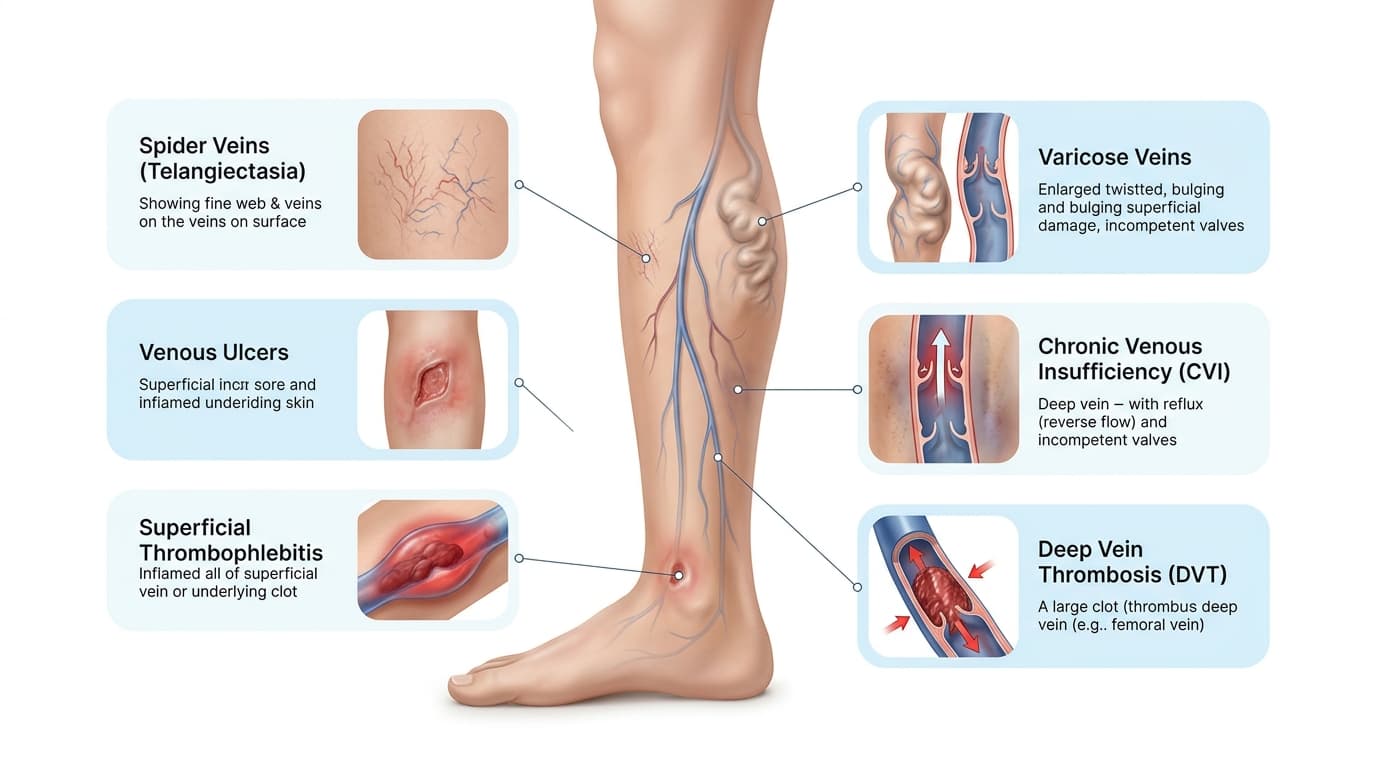
Types of Venous Disease
Venous disease can range from spider and varicose veins to chronic venous insufficiency, skin changes, and venous ulcers. Identifying the type and underlying cause helps us choose the right treatment for you.
Chronic Venous Insufficiency (CVI)
Weak vein valves allow blood to flow backward and pool in the legs, causing swelling, heaviness, and skin changes.
Varicose & Spider Veins
Varicose veins are enlarged, twisted veins; spider veins are smaller, web-like veins visible beneath the skin.
Deep Vein Thrombosis (DVT)
A blood clot forms in a deep vein, usually in the leg, and may cause swelling, pain, and warmth.
Superficial Thrombophlebitis
A vein close to the skin becomes inflamed and develops a small clot, causing tenderness, redness, or warmth.
Venous Ulcers
Slow-healing sores, usually around the ankle, caused by long-term poor venous circulation.
Swelling has many causes. Not all leg swelling is due to veins—cardiac, renal, lymphatic, medication, and clot-related causes should be considered.
Common Symptoms of Venous Insufficiency
Aching, Heaviness & Fatigue
A dull, tired, or throbbing sensation in the lower extremities relieved by leg elevation.
Skin Hyperpigmentation & Eczema
Dark browning or rust-colored skin staining (hemosiderin) near the inner ankles due to red blood cell breakdown.
Restless Legs & Night Cramps
Involuntary leg twitching or painful nocturnal calf spasms triggered by venous congestion.
Venous Stasis Ulcers
Slow-healing open sores above the inner ankle resulting from long-standing tissue breakdown and poor circulation.
What Triggers Vein Valve Damage?
Genetics & Family History
Over 70% of patients with venous reflux have a first-degree relative with vein disease.
Prolonged Standing or Sitting
Occupations requiring hours of stillness prevent leg calf muscles from pumping blood.
Pregnancy & Hormonal Shifts
Increased blood volume and pelvic pressure relax vein walls during pregnancy.
Age & Obesity
Natural loss of vein wall elasticity combined with excess abdominal pressure on venous return.
Prior Deep Vein Thrombosis (DVT)
Post-thrombotic syndrome damages vein valves following a major blood clot.
Diagnostic Testing
Accurate diagnosis begins with a comprehensive vascular ultrasound to assess vein anatomy, measure blood flow, and identify specific points of valve reflux.
Duplex Reflux Mapping
Measures valve reflux duration in seconds (>0.5s indicates valve failure) to pinpoint dysfunctional vein valves.
Saphenous Trunk Mapping
Maps the precise anatomical pathway and dimensions of the Great and Small Saphenous veins.
Perforator Vein Inspection
Identifies incompetent connecting veins between the deep and superficial systems contributing to swelling and skin breakdown.
Deep Venous Assessment
Evaluates deep vein patency to rule out Deep Vein Thrombosis (DVT) and obstructive venous compression.
Treatment
Modern venous treatments are minimally invasive, performed in-office with minimal discomfort and rapid recovery times, restoring healthy leg circulation.
Thermal endovenous ablation
Uses targeted heat energy from radiofrequency (RFA) or laser (EVLT) delivered via a thin catheter to seal shut the diseased vein, redirecting blood flow into healthier vessels.
Nonthermal glue ablation
Uses a specialized medical-grade adhesive delivered via catheter to close the diseased vein without requiring heat, tumescent anesthesia, or post-procedure compression stockings.
Microfoam ablation
Injects an ultrasound-guided physician-compounded microfoam into tortuous or complex diseased vein segments to gently displace blood and seal the vessel.
Sclerotherapy
Injects a targeted solution directly into spider veins and smaller tributary varicose veins, causing them to collapse and gradually fade from view.
Our goal is to recommend the least invasive, most effective vein treatment tailored to your ultrasound findings, symptoms, and lifestyle.
Lifestyle & Compression Protocol
Graduated Compression
Wear 20-30 mmHg prescription compression stockings during prolonged standing or travel.
Leg Elevation Routine
Elevate legs above heart level for 15-20 minutes 3 times daily to assist gravity venous drain.
Calf Muscle Flexing
Engage in regular walking and ankle flex exercises to activate calf muscle venous pumps.
Frequently Asked Questions
Ready for relief from leg swelling & vein pain?
Schedule a comprehensive vascular duplex evaluation with Dr. Almahmoud.